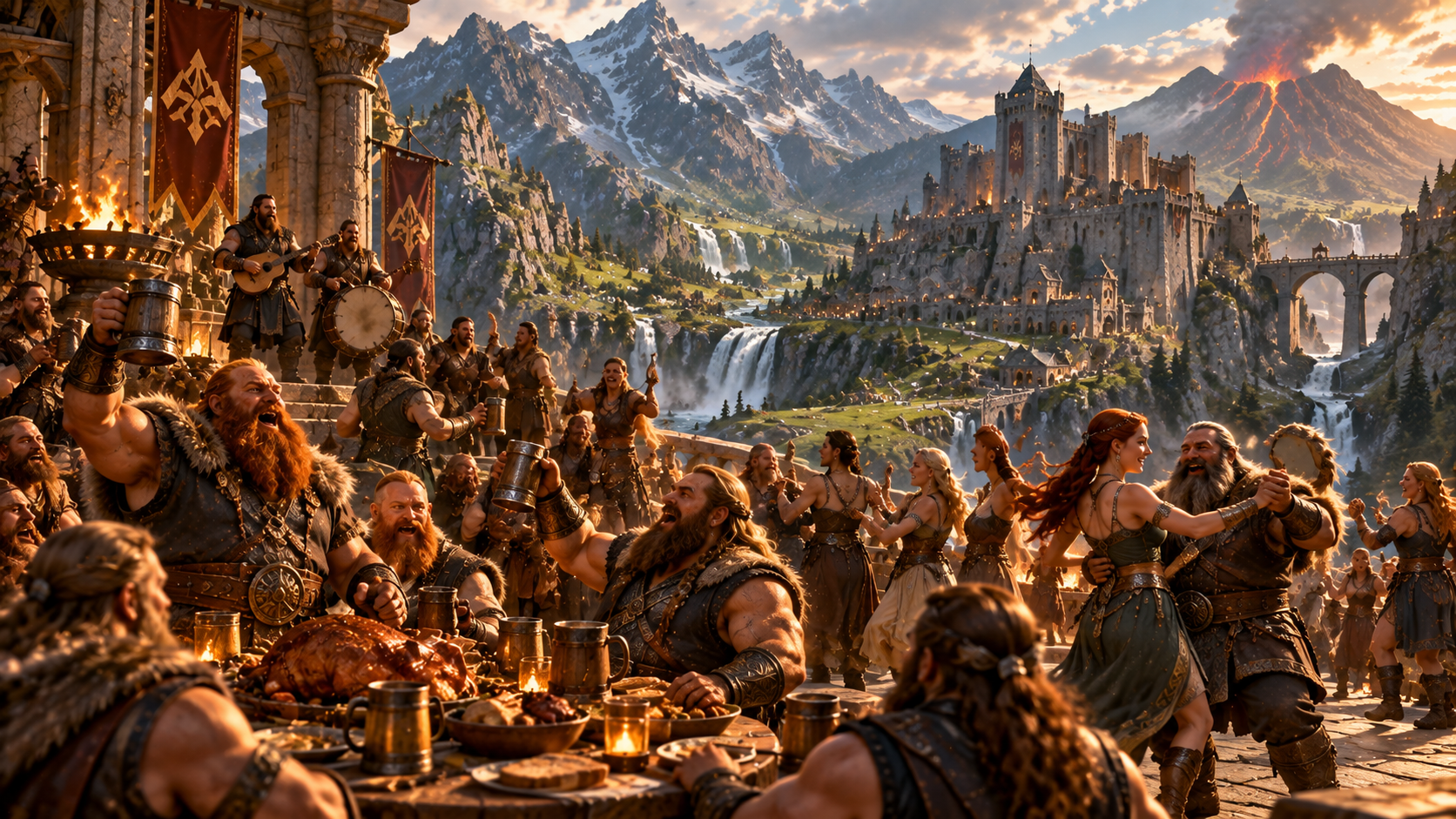
The scattered dwarven clans of the volcanic mountains and fertile steppes recognize Borri Barleybeard as the first King of Vulcania. Borri is remembered less for legislation than for his coronation feast. Over one thousand dwarves join to drink for three consecutive days while musicians perform on tables and warriors wrestle over vats of beer. The young kingdom develops a reputation for good beer, loud music, and rowdy dwarves.
The death of Borri the Merry leads to a dispute over grazing rights brings, bringing seven clans close to war. Queen Hilda Copperbraid instead invites their chiefs to a midsummer festival. After two days of drinking, dancing, wrestling, and competitive axe throwing, nobody can remember precisely what the original dispute concerned. The seven clans sign a grazing compact the following morning.
The dragon Varkhaz the Red descends from the northern mountains and attacks several mining settlements, carrying away livestock, gold, and dwarves. Warriors pursue him into the mountains. Most do not return. Varkhaz's raid begins of pattern of succssful dragon raids followed by unsuccessful revenge missions.
Warrior Durik Ironbelly leads forty dwarves into Varkhaz's lair. Only seven return, but Varkhaz is slain. Durik becomes a national hero, and dragon hunting develops into the highest expression of Vulcanian warrior culture. Songs portray death in battle as glorious, while taverns compete to display dragon teeth, scales, and bones.
King Olaf Rednose announces a celebration of a particularly successful harvest. Approximately three thousand dwarves arrive, causing royal breweries to run dry before sunset. Additional ale is acquired and festivities continue for five days, including dancing, drinking contests, fistfights, impromptu marriages, competitive singing, and the accidental destruction of the western gate.
The event becomes the standard against which all subsequent Vulcanian parties are judged.
Miners discover a cavern containing an ancient sleeping dragon. Rather than killing it, it persuades some of the miners to begin performing acts of worship. The dragon promises its followers immortality in exchange for gold, obedience, and blood. The cult secretly sacrifices two miners before authorities discover the shrine.
The dragon escapes. The cultists do not.
Transylvanian forces cross Vulcania's western frontier during a dispute over iron deposits. Vulcanian warriors initially treat the invasion as an opportunity for glory, with hundreds leaving their units to challenge enemy soldiers individually. After several disastrous defeats, King Thrain II imposes military discipline. Vulcania eventually drives the invaders from Blackstone Pass, but Vulcanian leaders begin questioning whether heroic individual combat is compatible with modern warfare.
To celebrate victory over three rival dragons, 1,728 dwarves gather in the capital. During the celebration, several warriors discover that one of the supposedly slain dragons is still alive when it crashes through the roof of the royal drinking hall. The resulting battle destroys six taverns and a brewery.
The dragon is killed, while the party continues around its corpse.
Dragon worship spreads quietly through mining towns and military units, as non-military dwarves seek purpose and direction. The Brotherhood of the Flame teaches that dragons are not monsters but superior beings whose strength proves their divine nature. Cultists believe worthy dwarves can become immortal by serving them. Disappearances increase.
Authorities begin find a sacrificial chambers beneath a seemingly ordinary home, sparking public outcry and a widespread investigation.
A coalition of seven dragons attacks the rich settlements of the Smoking Valley. Vulcanian warriors rally from across the kingdom. Thousands fight beneath the banner of King Torbjorn VIII. Four dragons are killed and the others retreat. King Torbjorn dies during the battle and becomes one of Vulcania's greatest warrior-kings. His death enshrines the romanticization of military sacrifice.
Metropolitan engineers begin surveying mineral deposits near Vulcania's eastern frontier. Disputes escalate into war. Vulcanian courage proves formidable, but Metropolitan artillery, mechanical logistics, and disciplined formations inflict terrible losses. The war ends without conquest, but Vulcanian leaders are horrified by how close their kingdom came to defeat.
Factories, foundries, fortifications, and permanent military academies expand afterward.
King Bruni Broadbelt attempts to revive the increasingly militarized kingdom's older traditions. He orders free beer distributed throughout the capital. Approximately 12,600 dwarves participate in what becomes the largest drinking festival in Vulcanian history. The celebration lasts four days. It is remembered as the last truly carefree national festival.
The ancient dragon Goryx the Golden defeats several rivals and brings about a tense and temporary dragon unity. Goryx declares himself King of Dragons and promises his followers Vulcania's mines, livestock, and accumulated treasure. Dragon cultists begin preparing for his arrival.
During a military banquet, cultists open the fortress gates to Goryx's forces. Hundreds of dwarves are killed. Investigators discover that miners, merchants, priests, and even members of the royal household belonged to the conspiracy. The revelation sparks renewed outcry against the cultists, followed by a terrifying seven-year-long inquisition.
Queen Helga Ironhand establishes the Office of Internal Vigilance to identify dragon cultists. Initially, its powers are limited to investigating military installations and government offices, but it quickly expands. Informants are paid. Letters are opened. Taverns are monitored. Travelers require identification papers near military zones. Dwarves accept the measures begrudgingly, but average folk are afraid to protest lest they spark suspicion.
Vigilance officers uncover a large dragon cult beneath the mining settlements of Ash Mountain. Hundreds are arrested, and dozens of confirmed cultists are convicted and executed. Others are accused by neighbors, rivals, creditors, former lovers, and ambitious officials. Trials increasingly rely upon confessions extracted under interrogation.
Long after the majority of the cultists have been caught and punished, the inquisition continues as a sense of paranoia begins to develop.
Dragon Emperor Coronakt launches the largest dragon offensive in Vulcanian history. Dragons descend upon towns while cultists sabotage fortifications from within. Vulcania responds with disciplined armies, enormous crossbows, artillery, fortified tunnels, and specialized dragon-hunting units. The dwarves survive, but survival transforms the kingdom. Military service becomes compulsory. Travel between provinces requires papers. Public gatherings are restricted. Every settlement receives a permanent Vigilance office.
The government permits 1,111 dwarves to attend the traditional midsummer drinking festival under heavy security. The specific number is chosen to ensure good fortune. Vigilance officers stand inside every tavern. Songs criticizing the government are forbidden. Strangers report one another for suspicious remarks. Several intoxicated dwarves are arrested after joking that dragons might make better kings. The beer remains excellent, but the dancing ends early. Older dwarves begin telling stories about the festivals where nobody worried about who was listening.
King Coal II announces plans to reduce the authority of the Office of Internal Vigilance, arguing that Vulcania cannot remain permanently governed as though invasion is imminent. Three weeks later, he is assassinated and replace by his son, King Coal III. Authorities announce that the killer belonged to a dragon cult, and the assassin dies during interrogation. No public trial occurs, while the Vigilance Office receives expanded powers.
Intelligence reports claim that Coronakt is preparing another invasion and that thousands of cultists have infiltrated Vulcanian society. The government launches mass arrests. Homes are searched without warning. Suspected cultists disappear. Entire families lose employment because of accusations against relatives. Warriors patrol railway stations and marketplaces. Citizens are encouraged to report suspicious neighbors. Real cult networks are uncovered, but thousands of innocent dwarven lives are upended.
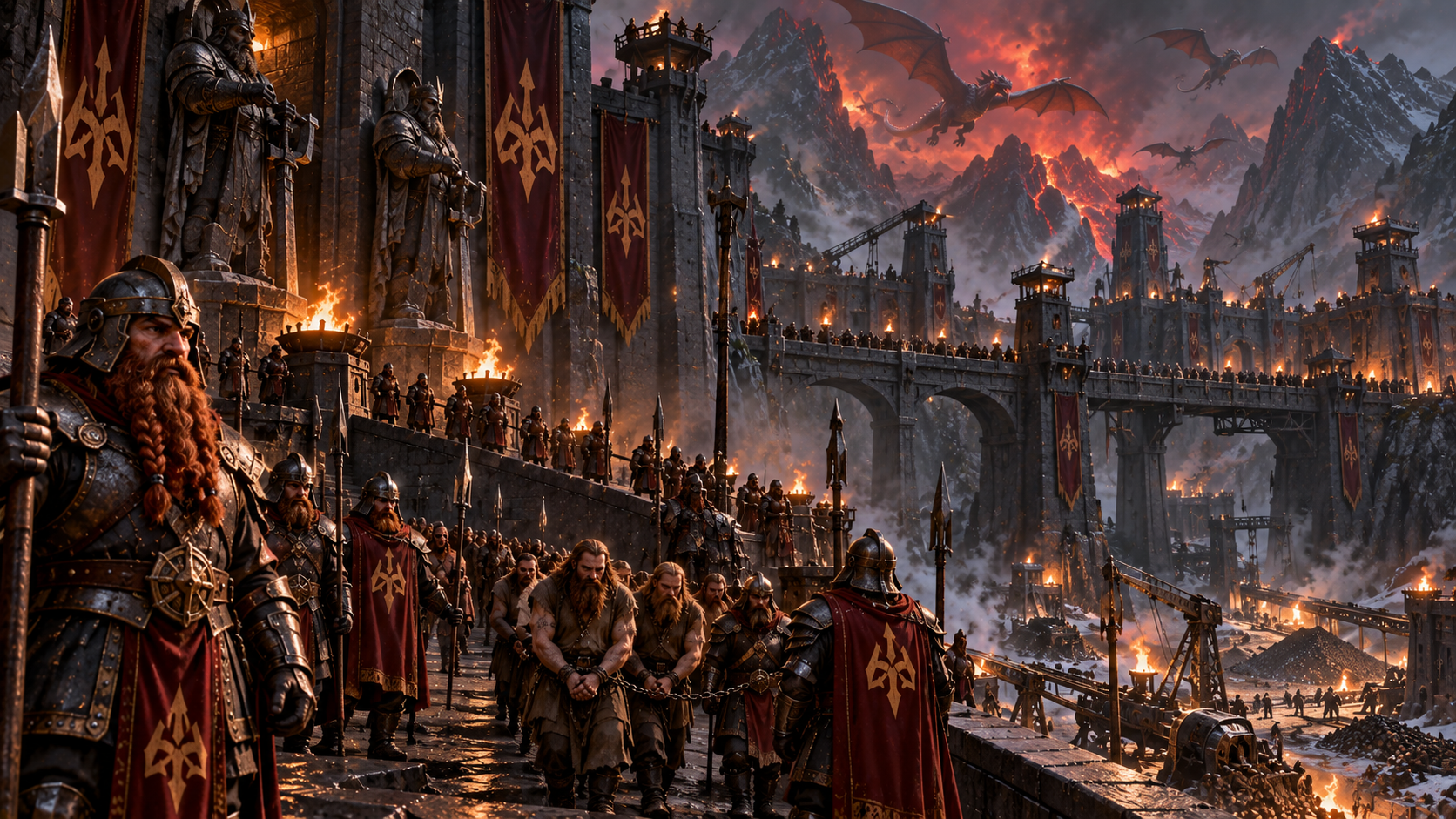
A thousand years after Borri the Merry celebrated his coronation by drinking with more than a thousand subjects, Vulcania remains standing.
Fortresses crown the mountain passes. Artillery batteries overlook the valleys. Underground bunkers connect towns. Warriors train from childhood to fight dragons, Metropolitan machines, Transylvanian invaders, and enemies within.
They mine. They farm the green valleys. They forge weapons. They raise families. They still drink heroic quantities of beer whenever circumstances permit. The old festivals have not entirely vanished. Music still escapes from tavern windows. Dwarves still dance on tables. Old friends still raise mugs and tell increasingly impossible stories about their youthful exploits.
But now someone at the next table may be listening. Dragons gather beyond the mountains. Coronakt's dream of conquering Vulcania has not died. And the cultists lurk seemingly behind every corner, threatening to upend all that Vulcania holds dear.