
His story begins with love. Yes, Lutis the Mad was once a lover. He fell head over heels for a girl named Constantia, a beautiful and terrifying brunette who wielded magic almost as powerful as his own. She loved him back, and within a blink they were wed. They enjoyed many centuries—yes centuries!—together, studying immortality, lichdom, and the abyss. But as time began to take its toll, they became desperate, and then depraved.
Constantia was the first to break. She committed an act of murder at the behest of a group known as the kraken priests, who had a credible claim to knowledge of immortality. When Lutis discovered what she had done, he chastised her, though he found himself sympathetic to her reasoning and unable to deny the joy brought by the hope of reliving their glory days, not merely for a few years but for all eternity. And so, in time Lutis too became a murderer. Alas! The act shook him, in ways it never shook Constantia: he felt sick to his core, and swore never to repeat such a heinous act. He stormed from the scene and hurried home to confront Constantia.
She was gone. Every clue pointed toward the same dreadful conclusion: Constantia had followed the Kraken Priests into the Abyss, a nightmare realm of impossible monstrosities, accumulated treasures, and perversely warped magic. Lutis and Constantia had ventured there together many times in search of the legendary chalice of immortality, but never like this. Now she was alone and in the hands of the most wretched and diabolical cult in the entire multiverse. Worse still, the Abyss played strange games with time. Within its depths, time crawled; years experienced there could become centuries in the world outside. Anyone who descended too deeply might return to discover that everyone and everything they had ever known had vanished into history.
And so, wrenched in his heart by horrific guilt and despair, he downed a fifth of vodka, opened a gateway to the Abyss, and stumbled through after her.
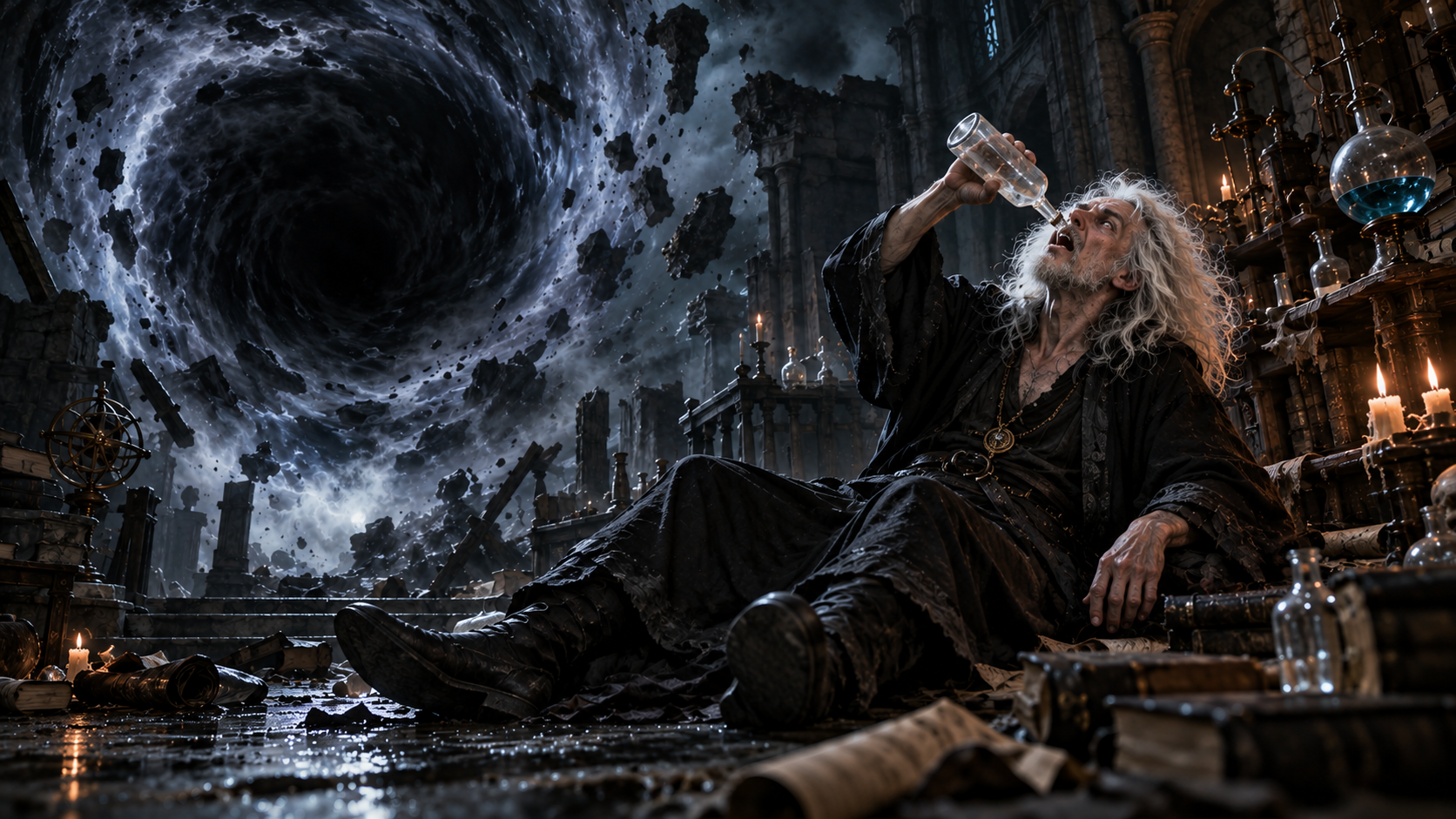
Millennia passed. Kingdoms rose and fell. Lutis’s contemporaries became historical figures, then legends, then footnotes, and finally names no one remembered at all. Yet deep within the Abyss, where the clock moved at its own sluggish pace, Lutis continued his search. He crossed impossible landscapes, fought creatures that should never have existed, and followed every rumor of the Kraken Priests deeper into realms from which sane wizards fled. The world assumed Lutis the Mad and his wife Constantia had died thousands of years ago. It was wrong.
At last, Lutis found Constantia. He shuddered with anticipation and joy, and then with confusion and despair as he beheld the hatred in the eyes of the woman he had worked so hard to save. The Kraken Priests had broken and remade her, twisting her memories and sharpening her tremendous magical power until Constantia had become their ultimate weapon. She attacked. A single tear fell down Lutis' cheek as he fought and subdued her, refusing to kill the woman for whom he had sacrificed not only his mind but even his soul.
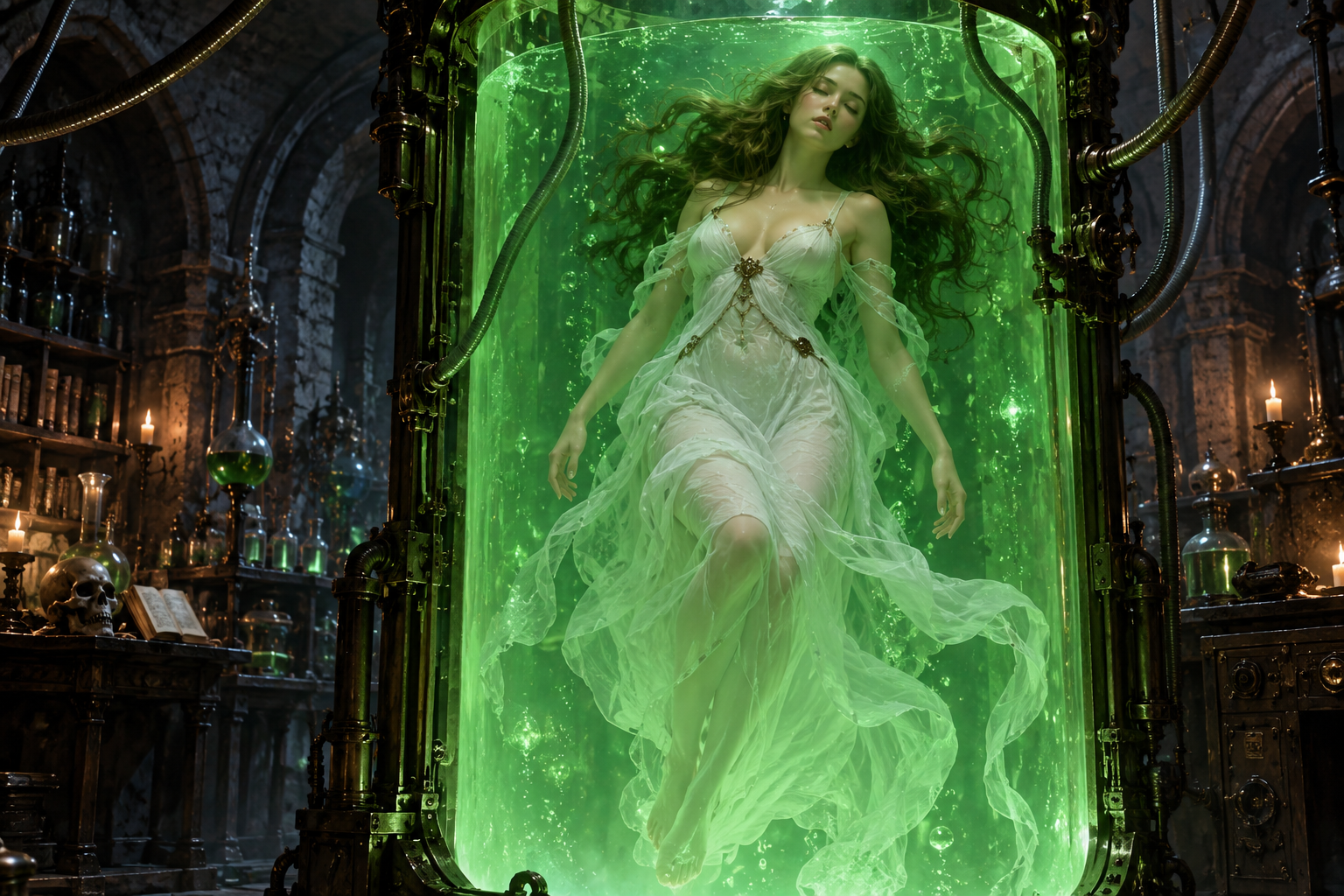
Constantia now sleeps suspended within a tank of luminous green liquid in Lutis’s laboratory, hidden somewhere deep within the Abyss. There he works ceaselessly to undo what the Kraken Priests did to her—to restore her mind, her memories, and most importantly, her love for him. Meanwhile, the ancient couple’s remaining years continue to dwindle. Even in the abyss, time ticks away relentlessly. And so, Lutis remains hell-bent on his quest, staying alive through sheer willpower centuries after every sign of life ought to have ebbed, in order to restore the love he once knew.
So tell me: is Lutis truly mad? Or is this love? You decide.