Wizard Wars Rules
The Game
A game consists of 3 rounds. In each round, players take turns playing cards until they pass. When both players have passed, the round ends and players tally up points to determine who has won the round. The first player to win two rounds wins the game.
Deckbuilding
In order to play the game, both players must construct a deck by choosing at least 30 cards. The cards selected are subject to certain constraints, as follows:
- Each card must be from the chosen faction, or be unaffiliated (factionless).
- The total provision cost of the chosen cards may not exceed 130.
- The deck may not contain more than 1 leader card.
- The deck may not contain more than 1 copy of each rare or legendary card.
- The deck may not contain more than 2 copies of each common card.
Every card has a provision cost, which is displayed in the lower right corner of each card. Provision cost roughly determines how many points the card will play for. Importantly, the total provision cost of all cards in a deck cannot exceed 130. The ideal deck contains exactly 30 cards and 130 provisions. Although it is possible to exceed 30 cards or go under 130 provisions, this is seldom advisable.
Once you have a deck that meets these requirements, you are ready to play the game.
Card Lifecycle
During the game, cards can exist in one of five locations: the deck, the hand, the battlefield, the graveyard, or the sideboard. In addition to these, cards can sometimes be introduced from outside the game, or banished from the game. Cards which are banished are sent to the banish pile, but are no longer in play or considered to be part of the game.
In general, cards are drawn from the deck into the hand at the start of each round and then played from hand to the battlefield during the round. At the end of each round, cards on the battlefield are moved to the graveyard. Cards in hand after a round remain in hand and may be played in subsequent rounds.
Card Types
Every card is either a unit, tactic, equipment or emplacement.
-
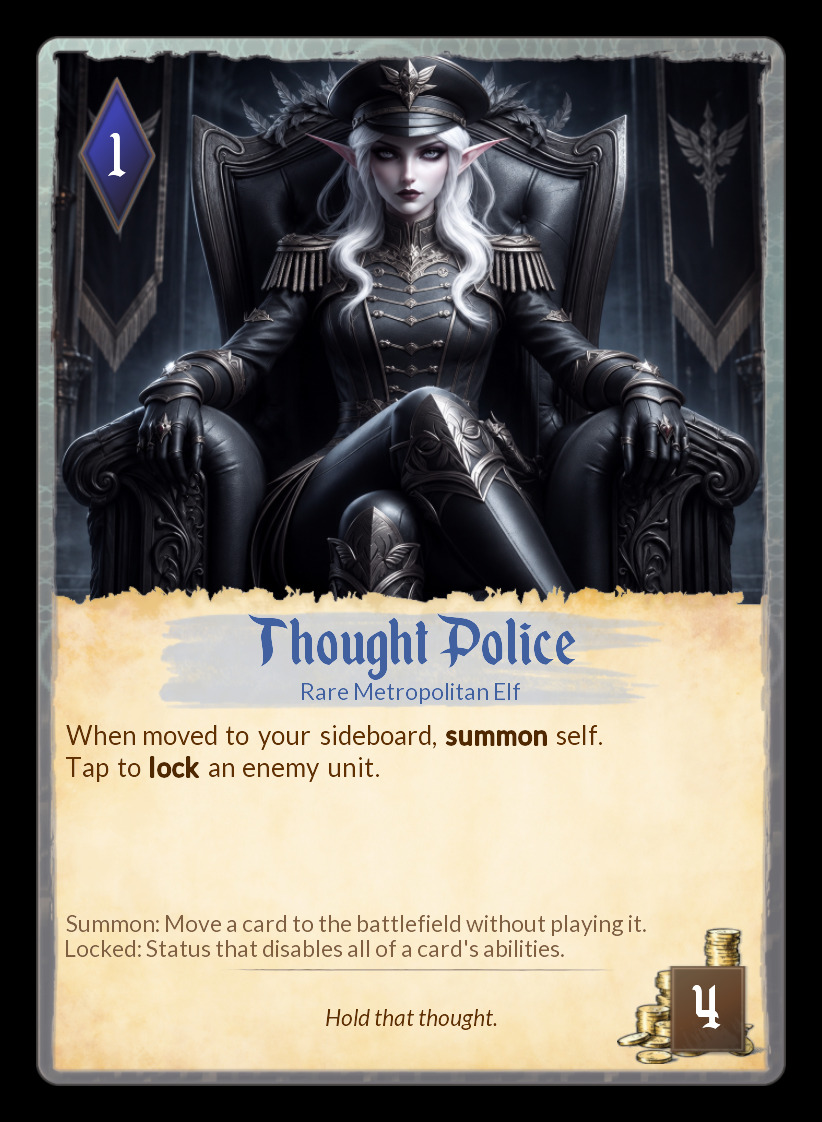
Unit cards are distinguished by their power score in the upper left corner. They are played to the battlefield and their power contributes to your score at the end of the round. Unit cards may also have an armor number displayed in the lower left, which makes them more resilient versus enemy attacks.
Players can answer a threatening unit card via an assault or assassination, or by playing a card with the "lock" ability. Some cards can also destroy a card instantly.
An example of a unit card is displayed on the right.
-
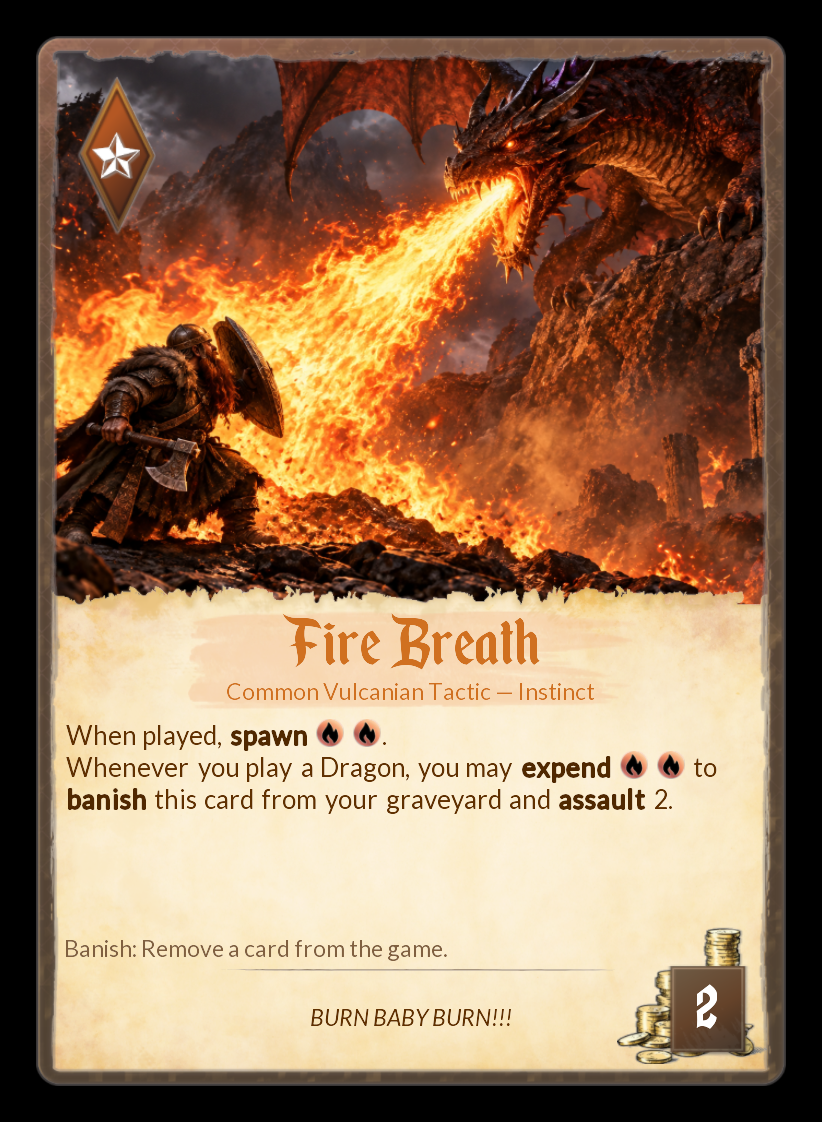
Tactic cards are distinguished by a star in the upper left corner. They take effect instantly and then enter the graveyard, and do not have a power score or remain on the battlefield.
Some tactic cards have the "echo" property, which allows them to be played a second time during the third round of the game. If the echo property is present, it is displayed alongside the card text.
An example of a tactic card is displayed on the right.
-
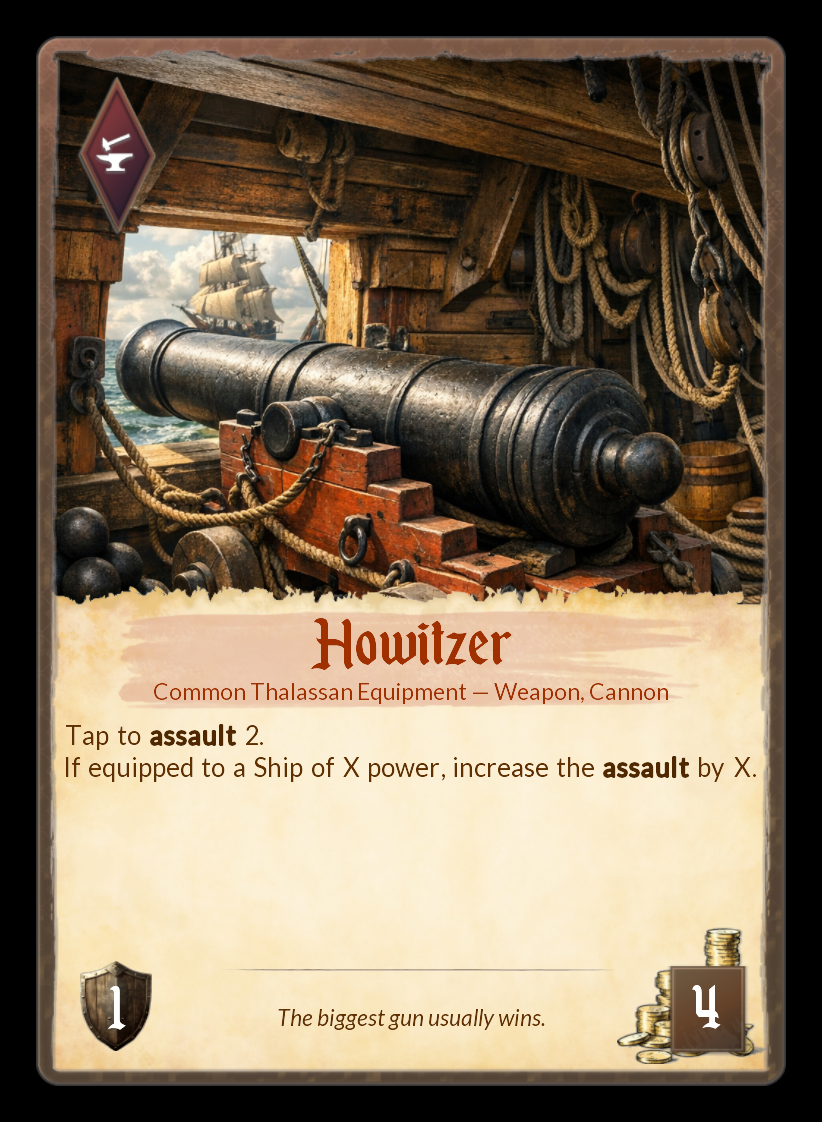
Equipment cards are distinguished by a hammer and anvil icon in the upper left corner. They are attached to a unit, referred to as the equip target. A unit can have multiple equipments, but if it is destroyed or banished, all equipment is moved to the graveyard. Equipment can also have a power and armor number, which (if present) are added to the power and armor of the target unit, making it more resilient against enemy attacks.
An example of an equipment card is displayed on the right.
-
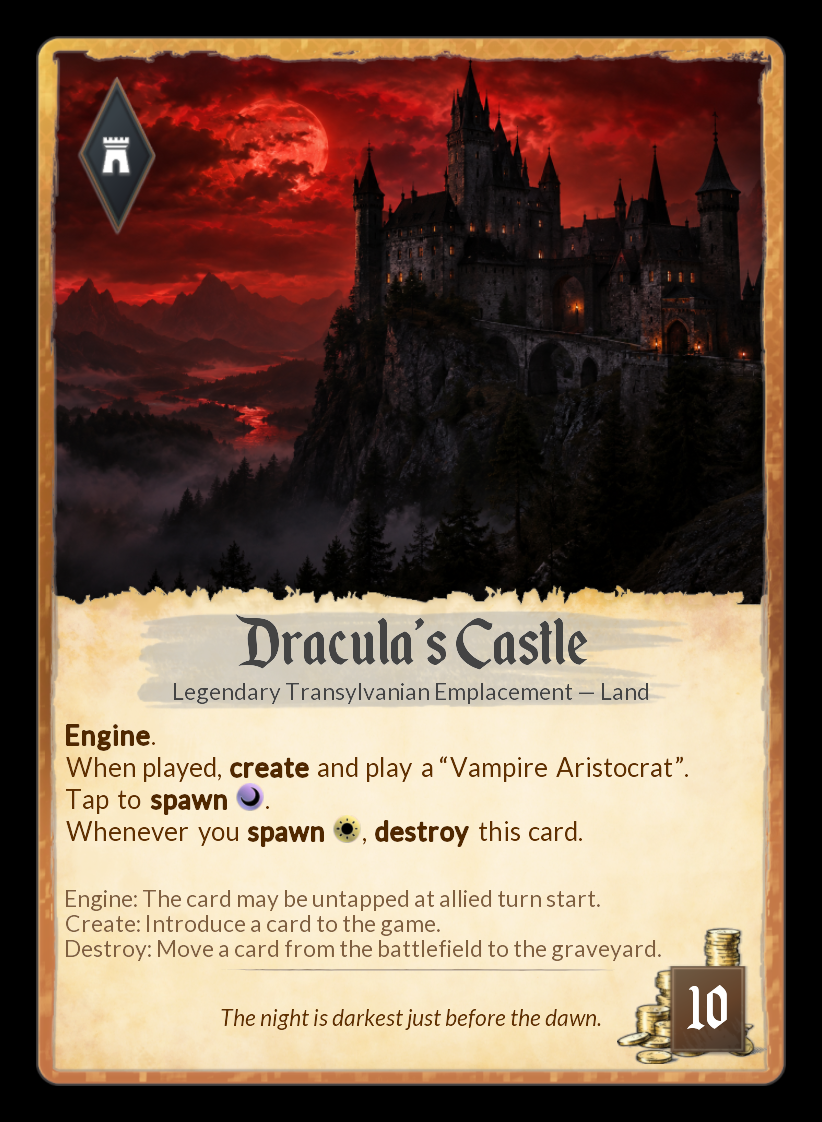
Emplacement cards are distinguished by a castle icon in the upper left corner. They are played to the battlefield, but do not have a power score.
Although they are similar to units, they are more difficult to remove from the battlefield, because few cards have the "destroy emplacement" ability.
Emplacements have two main subcategories: Land, and Location — but not all emplacements fall into either of these categories. Land cards generate mana over time, while Location cards possess the "stalwart" property, allowing them to remain on the battlefield after the end of the round.
An example of an emplacement card is displayed on the right.
Starting the Game
At the start of the game, all 30 cards are in deck and the battlefield and graveyard are empty. To begin the game, players follow a series of steps:
- Certain cards begin the game in the sideboard or graveyard. These cards should be moved to the appropriate location before the deck is shuffled.
- The deck is shuffled.
- Players toss a coin to determine who will go first. Going first is a disadvantage, so the player who plays first starts the game with a 3 point unit (Bird of Victory) already on their battlefield.
- Each player draws 10 cards.
- Each player takes up to 2 mulligans.
- Players roll the common mana dice and place their allied mana dice with the desired faces up. (The purpose of mana dice will be explained later.)
The game is now ready to begin.
Note: In order to take a mulligan, a player places a card from their hand face down in a temporary mulligan pile, and then draws a new card. After the player is finished taking mulligans, the mulligan pile is placed at the bottom of the deck in any order. A player need not take every available mulligan, but once a mulligan is taken cards cannot be moved from the mulligan pile back into hand.
Playing the Game
Each turn has a certain structure. First, all damage dealt to units is healed, as damaged units are restored to their base power. Second, “turn start” card abilities are triggered in order from left to right. Then, the player must decide to play a card or pass.
If they choose to pass, they play no cards and may not play, tap, or untap cards for the remainder of the round. The player becomes inactive, though card passive abilities continue to take effect. In addition, their “when you pass” card abilities immediately trigger in order from left to right, at which point their score is added up. However, this score may be decreased if their cards are destroyed, or increased as passive abilities continue to trigger. Note that if a player has no cards in hand at the start of their turn, they automatically pass.
If they choose not to pass, the player may tap or untap cards before playing a card. Once a card is played, other cards may not be tapped or untapped until all “when played” abilities have been resolved. After a card has been played, the player may again tap or untap cards until either all available card abilities are exhausted, or the player ends their turn. Note that if a player cannot play a card from hand, they may perform a manual discard by moving a card from hand to the graveyard. This allows them to stay in the round by avoiding a pass turn.
After the player has played or passed, it becomes the opponent’s turn and the turn cycle begins again.
Round Transition
There is a specific process that happens at the end of rounds. First, all points are tallied and a winner or draw is declared. Then, all cards (except stalwart and doomed cards) on the battlefield are moved to their owner’s graveyard, clearing the battlefield for the next round. (Stalwart cards are purified, equipment is removed, and remain on the battlefield. Doomed cards are moved to the banish pile.) The round has now ended, and the next round begins.
First, players shuffle their decks and the draw phase of the round begins. If there are any echo cards in either player’s graveyard and it is the beginning of the third round, they may be moved to the top of the deck here. Next, players draw three cards from the top of their deck and take two mulligans. Play is now ready to resume. Whoever won the previous round takes the first turn of the next round.
Draws
- If round 1 is drawn, whoever went second in round 1 goes first in round 2. Whoever wins round 2 wins the game. If round 2 is also drawn, the game is a draw.
- If round 2 is drawn, whoever won round 1 wins the game.
- If round three is drawn, the game is a draw.
Mana
Mana is represented by a special six-sided die, with colored icons for each element. During the game, the types of mana available affect which abilities may be activated.
There are six types of mana:
- Fire (Red flame)
- Water (Blue water drop)
- Earth (Green leaf)
- Air (Aqua lightning bolt)
- Light (Yellow sun)
- Dark (Purple moon)
Mana dice are either owned by a specific player or neutral. Each player's available mana is based on their personal pool plus the neutral pool. The game starts with each player owning three mana dice plus three neutral mana dice, with each player having access to six of the nine total mana dice. Players spawn (gain) mana by setting a die to a specific face, and expend mana by rerolling mana of a specific face.
Mana dice persist from round to round. Players can set their personal mana dice to any color they wish at the start of the game, but neutral mana dice are rolled randomly.
Clarifications
The battlefield has a specific structure, which makes the relationships between cards readily apparent to all players.
- Unit and emplacement cards are played face-up on a row, with every card (except those on the end) having a left and right hand neighbor.
- Ordinarily, cards may not be played between other cards. Unless card text says otherwise, a unit or emplacement must be played to the left or right end of the battlefield.
- Equipment cards are played behind the units to which they are attached, also face up.
- All cards are played in the portrait orientation, but may be rotated to landscape to indicate when they have been tapped, and rotated back to portrait when they have been untapped.
- Equipment cards are tapped separately from the units to which they are equipped. It is possible for a unit to be tapped and its equipment untapped, and vice versa.
- Disloyal cards are played to their opponent’s battlefield, and their power contributes to their opponent’s score.
- Upside down cards are returned to the opposite graveyard. Cards become upside down when they are played disloyally or if they are seized.
- Players may inspect cards on the battlefield, as long as they are careful to return the card to its original position after it has been inspected.
In addition:
- Cards in the graveyard or sideboard have no particular order, are kept face up, and may be inspected by either player.
- Cards in hand have no particular order, and are held facing away from the opponent.
- Cards in deck are kept in order and are hidden from both players.
Keywords
Some words, called keywords, have special meanings in the context of this game. Keywords allow for card text that is both concise and precise, but can be confusing to new players. Most keywords have an explanation included below the card text on any card where they are used, but some extremely common keywords do not have help text. In addition, there are some cases where the full help text is too expansive to fit on the cards where the keyword is used, so a shortened help text is included. Here is a list of all keywords used in the game, with a full explanation.
The following keywords are part of the core rules of the game, and do not have help text:
-
Spawn
To spawn mana of a specific type means to take a common or allied mana die of your choice and turn it to a specific face. This is done to set up “expend” card abilities.
-
Expend
To expend mana of a specific type means to take a common or allied mana die of that type and reroll it. Even if it comes back to the same face it was originally, it counts as having expended the mana. Expending mana is the inverse of spawning mana, and is required for many card abilities.
-
Play
Move a card to the battlefield, triggering its “when played” ability. (As opposed to “summon” which bypasses the “when played” ability.)
-
Assault X
To assault X means to initiate damage against an enemy unit. If the damage equals or exceeds the target's power plus armor (including power and armor from equipment), the target is destroyed. If the unit is not destroyed, it is left in a damaged state until the beginning of its owner’s turn. Note that an assault cannot target invisible or protected units.
Here is an exhaustive list of all official keywords used by the game:
- Destroy: Move a card from the battlefield to the graveyard.
- Create: Introduce a card to the game.
- Discard: Move a card from hand or deck to the graveyard.
- Banish: Remove a card from the game.
- Assassinate X: Assault X, bypassing protection and invisibility.
- Seize: Move a unit to its opponent's battlefield.
- Toughness X: A unit's power plus its armor.
- Armor: Increases a unit's resistance to assault.
- Overkill X: Triggers when dealing X or more excess damage.
- Haste: The card can be tapped on the turn it is played.
- Engine: The card may be untapped at allied turn start.
- Summon: Move a card to the battlefield without playing it.
- Create: Introduce a card to the game.
- Disloyal: The card is played to your opponent's battlefield.
- Chaos X: Triggers if there are at least X unique mana types among common and allied mana dice.
- Paired: Triggers if you control another copy of this card.
- Echo: At round 3, before drawing cards, move this card from your graveyard to the top of your deck.
- Imbibe: Triggers whenever a Liquor card is equipped.
- Tall: Counters on this unit contribute towards its power.
- Devour: Destroy a unit and gain counters equal to its power.
- Plunder X: Gain X points when the unit is destroyed.
- Harmony: Triggers whenever you play or summon a unit with a unique racial category.
- Diversity X: Triggers when you control X unique racial categories.
- Devotion: Triggers if your starting deck contains no unaffiliated cards.
- Veteran: Increase this unit's power at the start of the second and third round.
- Purify: Remove all statuses from a unit.
- Locked: Status that disables all of a card's abilities.
- Poison: Status that destroys a unit if inflicted a second time.
- Doomed: Status that banishes a card when it leaves the battlefield.
- Bounty X: Status that lets your opponent spawn X mana of any colors when the unit is destroyed.
- Stalwart: At round end, units with this status are purified instead of destroyed. Equipment is also destroyed.
- Protector: Status that prevents adjacent units from being targeted by their opponent. A protector cannot be protected.
- Invisible: Status that prevents the unit from being targeted by the opponent (except purify).
- Immune: Status that prevents receiving additional statuses.